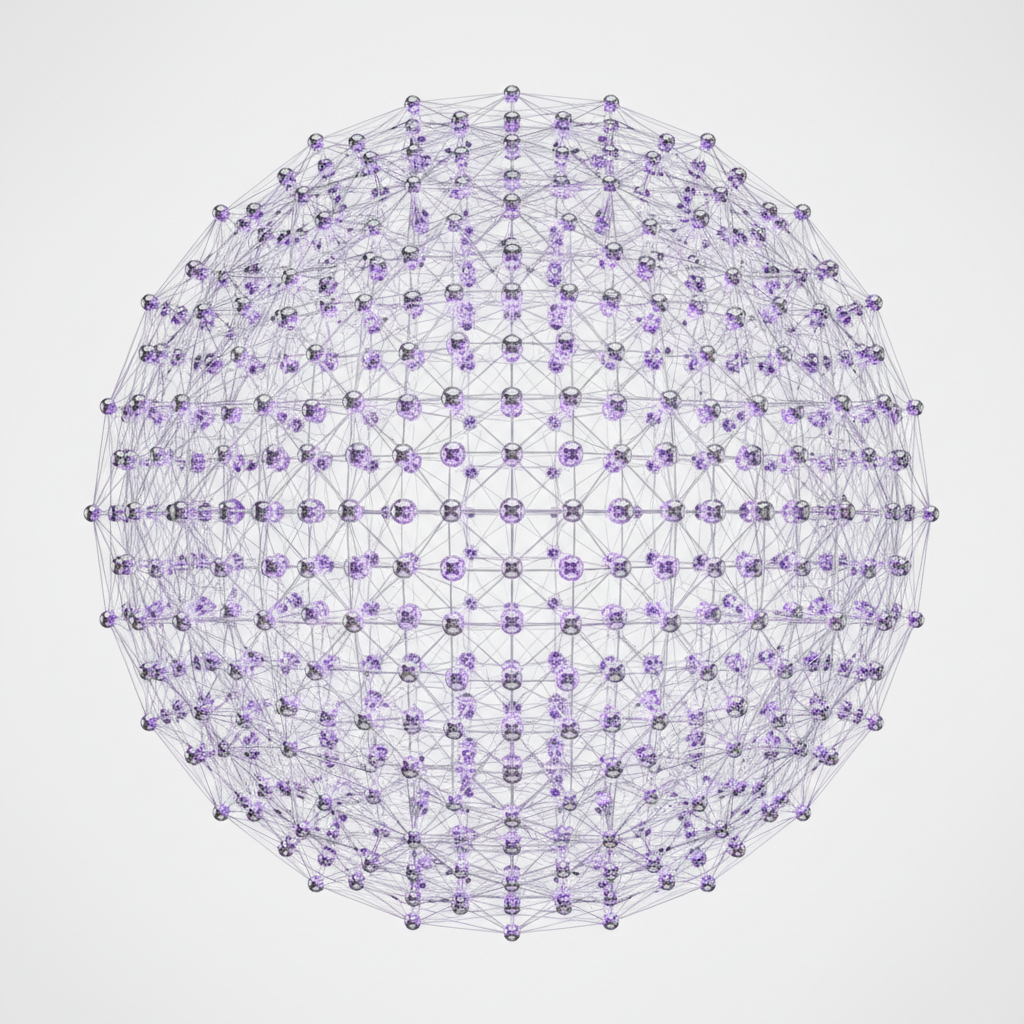
01 — The Latent-Space Paradigm
Quantization as an Eigenvalue AI problem.
MoC-JEPA (Moment-driven Charge Density Joint Embedding Predictive Architecture) and Qiankun Net combine into a single latent-space pipeline: many-body complexity is folded into a compact set of latent eigenmodes, then unfolded into high-fidelity observables — collapsing exponential simulation cost into linear-time discovery.
Many-body complexity
Raw quantum many-body systems — exponential degrees of freedom, intractable for classical solvers.
Latent eigenmodes
MoC-JEPA's latent bridge compresses the wavefunction into a small set of predictive eigenmodes.
Linear-time discovery
Qiankun Net reconstructs high-precision observables — turning O(N⁷) into linear-time inference.
MoC-JEPA
Foundation Model
Qiankun Net
High-Precision Quantum Representation
Linear-Time Discovery
Faster. Scalable. Transformative.
Technology
Public Research.
Our dedicated home for open research, whitepapers on Equivariant Manifolds, and our publications across AI for Science. The full technology archive is being prepared.
- Whitepapers on Equivariant Manifolds & the Quantum Onion Model
- MoC-JEPA architecture deep-dives and latent-space deduction
- Qiankun Net high-fidelity dataset documentation
- Peer-reviewed publications in AI4S